

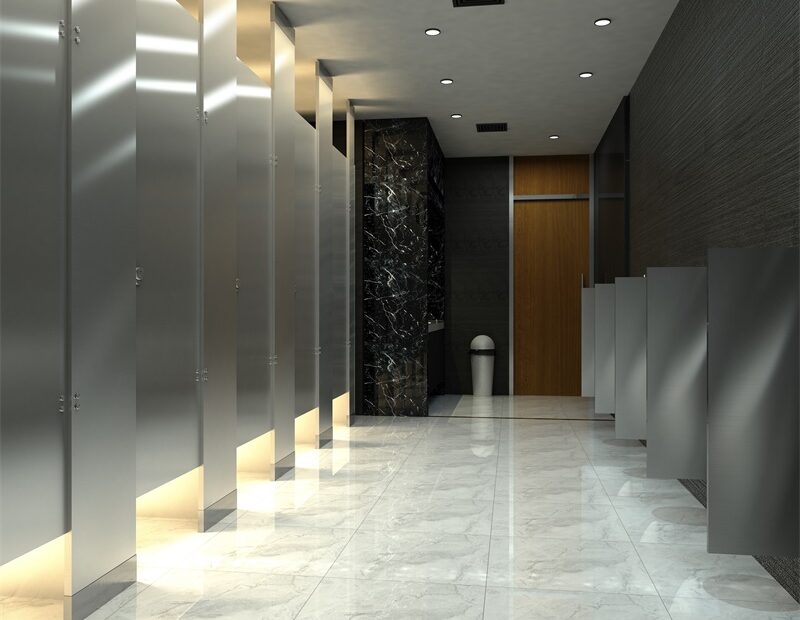
Maximizing Privacy and Comfort: Reasons to Choose Toilet Cubicle Partitions
Toilet cubicles provide a level of privacy and comfort not available with an open concept bathroom. Here are just a few reasons why a toilet cubicle partition is an ideal choice over an open bathroom space:
Enhanced Privacy
- Each cubicle is its own enclosed space where occupants can have the privacy they need.
- The cubicle walls block out unwanted noise and reduce sound echoed from adjoining stalls.
- No one can see or hear what happens in your cubicle.
Reduced Splashes & Spills
- The walls of the cubicles create a barrier to splashes and spills, keeping them from occurring across the room.
- This reduces the need for frequent cleaning and makes the entire bathroom easier to maintain.
Enhanced Comfort
- The walls of the cubicles also create a sense of security, making it easier to relax and be comfortable in the space.
- The walls also block out cold air entering the bathroom, minimizing drafts, and providing a more comfortable environment.
Space Efficiency
- A toilet cubicle partition takes up less space than an open plan bathroom, maximizing available space for other features.
- These partitions can be used to create more efficient and comfortable toilet areas with minimal space requirements.
Toilet cubicles are an ideal choice for anyone who wants to maximize privacy and comfort in their bathroom. They provide a high level of privacy and create a secure, warm, and pleasant environment in which to use the toilet. Furthermore, these cubicles are space efficient and help reduce unwanted splashes and spills, making them a great choice for any restroom.
How much does it cost to install toilet cubicle partitions?
The cost to install toilet cubicle partitions will vary depending on the number and type of partitions, the materials used, and the installation complexity. Typically, cubicle partitions may cost anywhere from $600 to $3,000 or more.
Are toilet cubicle partitions required by building codes?
Yes, in many cases, restroom partitions are required by building codes. This is usually dependent on the number of rooms and type of segments, as well as other factors. Check with your local building codes to determine if toilet cubicle partitions are required in your area.
How long does it take to install toilet cubicle partitions?
The time necessary to install toilet cubicle partitions depends on the design, number of cubicles, installation complexity, and any existing condition concerns on the jobsite. Depending on all of these factors, installation times can range from a few hours to up to a day or even longer.
How much do toilet cubicle partitions cost?
The cost for toilet cubicle partitions can vary depending on the type, size, and material of the partitions. Generally, partitions cost somewhere between $4,000 and $10,000 but can be higher if special features are included.
How long does it take to install toilet cubicle partitions?
It usually takes about 2-4 hours for two people to install standard toilet cubicle partitions. However, this could take longer if there are complex or intricate designs involved.
How much does it cost to install toilet cubicle partitions?
The cost of installing toilet cubicle partitions will vary greatly depending on the type and number of partitions, the complexity of the installation, and the size of the space. Prices typically range from $50 to $250 per partition.
What materials are used to make toilet cubicle partitions?
Toilet cubicle partitions are typically made from either high-pressure laminate or solid plastic panels. The panels are usually connected by steel or aluminium frames with integral hinges, handles, and locks. Toilet cubicle systems are often finished with adhesives to prevent water from seeping through the seams.
What is the difference between plastic and metal toilet cubicle partitions?
The main differences between plastic and metal toilet cubicle partitions are their durability, cost, and installation methods. Plastic partitions are made from high-pressure laminate, which is lighter and more cheerful looking than metal. Plastic partitions are usually easier and faster to install, but in general, plastic partitions are not as durable as metal partitions. Metal partitions tend to be more expensive than plastic partitions but also offer better protection from damage. Metal partitions also require more specialized installation methods and are harder to maintain.

